Posts Tagged With: missionary work

Understanding the Size of South Africa: An Overlay and Overview

Whether chatting with friends or discussing our ministry in South Africa, people often ask us, “How big is South Africa?”

While we lived in South Africa, we spent a weekend visiting Cape Agulhas, Africa’s southernmost tip and the boundary between the two oceans.

South Africa is the 24th-largest country in the world and the ninth-largest country in the continent of Africa. Its 471,445 square miles make it about one-eighth the size of the United States. It borders the Atlantic Ocean on the west and southwest and the Indian Ocean on the southeast and east.

A good way to visualize it is to imagine it overlaid with the southeastern United States.

The shapes of the two countries’ coastlines are relatively similar (minus the Florida peninsula), so if you align Cape Town approximately with New Orleans, then South Africa would follow the US coast to Virginia Beach, with the city of Durban roughly equal to Wilmington, North Carolina. The neighboring cities of Pretoria and Johannesburg would be roughly west of Roanoke, Virginia, and the northeastern tip of the country would extend into New York state’s Southern Tier region. South Africa’s western tip would be in Arkansas, and its curving northern border would include Columbus, Ohio, and St. Louis, Missouri.

The website TheTrueSize.com (https://www.thetruesize.com/) enabled me to make this overlay of South Africa and the eastern USA (map link below the screenshot).
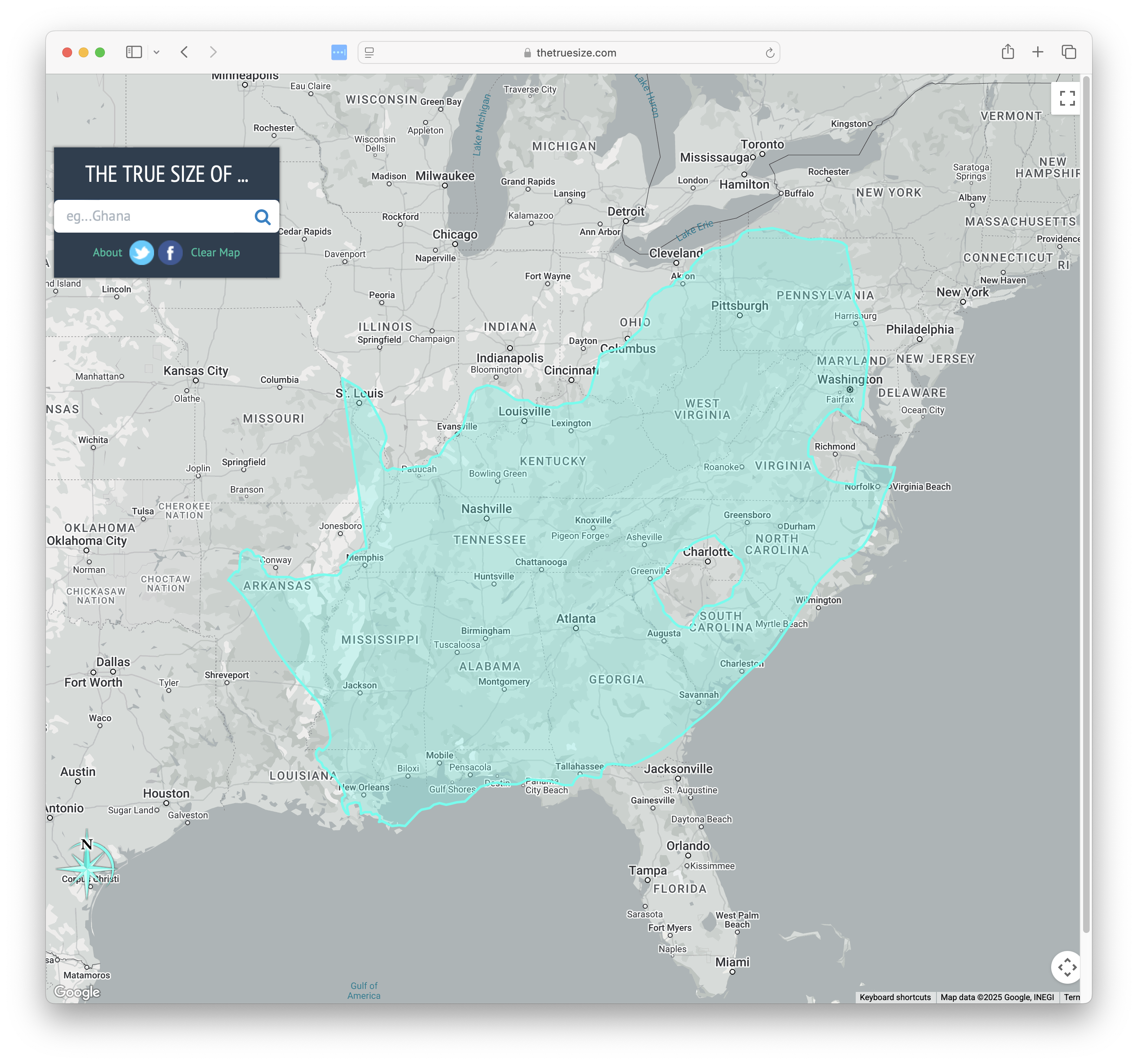
https://www.thetruesize.com/#?borders=1~!MTM1Nzk0MjI.MTEzNDk4MzY*MTE1NzQ2Mzg(Nzk5NTI5Mg~!CONTIGUOUS_US*MTM2MjM1MDA.MjgxODUyODI(MTc1)MA~!ZA*MTM1MDM4NjE.MTA2NzYxMjQ)MA

Some other details:

  • South Africa has over 62 million people, and its largest city is Johannesburg, with 4.8 million people in the city itself and nearly 7.9 million in the overall metro area. The country distributes its government into three capitals: the executive branch in Pretoria, the legislative in Cape Town, and the judicial in Bloemfontein.
  • Driving between far-flung cities is more difficult and expensive than here in the US, so air travel is often preferred.
  • It has 12 official languages—Zulu, Xhosa, Afrikaans, English, Pedi, Tswana, Southern Sotho, Tsonga, Swazi, Venda, and Southern Ndebele (from most spoken to least as a first language), as well as South African Sign Language. English is used as the lingua franca.
  • While most South Africans are Christian, many secularize it or syncretize that faith with other belief systems, and there are large populations of Muslims, Hindus, traditional African religions, Jewish people, and people who are non-religious.
  • Many non-Christians come to South Africa as refugees or migrant workers from other countries where it can be harder for Christian workers to go, allowing them to learn about Christ in South Africa and sometimes to take that introduction to their own families and friends in their home countries.
  • Rates of unemployment and crime are high, with many factors and challenges contributing.
  • There are always ministry needs and opportunities among South Africa’s many peoples and communities. We are grateful to be part of the work of meeting those needs and loving people in Christ’s name.

Please join us in praying for South Africa: the country; its leaders, government, and economy; and its people—that every one would find peace, safety, prosperity, and joy in their daily needs and their eternal ones. Thank you.

Categories: Stories, News, & Features | Tags: , , , , , , , , , , , , | Leave a comment

Read about what God is doing through missionaries in and from South Africa! (SIMnow #157)

The online editions of SIM South Africa’s SIMnow Autumn (March) 2024 magazine are available.

This is the seventh issue I have compiled and edited, and we continue to get good feedback about it from readers.

A challenge, though, is that getting the magazine to the readers is increasingly difficult. South Africa’s postal system faces many challenges itself, and those sometimes delay or prevent delivery for our readers.

We have long posted the PDFs of our magazine online to help alleviate this, but we recognize that PDFs of two-page magazine spreads aren’t easy to read on a phone, which is where most reading happens nowadays. While we are working to develop a more suitable long-term solution, we have created a one-page-wide adaptation of the magazine for distribution by WhatsApp, which is a very popular app in and around South Africa.

“Many have undertaken to draw up an account of the things that have been fulfilled among us, just as they were handed down to us by those who from the first were eyewitnesses and servants of the word. With this in mind, since I myself have carefully investigated everything from the beginning, I too decided to write an orderly account for you, most excellent Theophilus, so that you may know the certainty of the things you have been taught.”

Luke 1:1-4 (NIV)

Articles this time included:

  • a brief story about the founding of Young Legends, a youth soccer program in three cities of South Africa.
  • a story about two of our workers developing a farm into a community and youth ministry center.
  • a farewell message from SIM’s former international director and an article introducing our new one.
  • an article and photos from a conference helping African churches send missionaries
  • a “Why I Wrote” books feature by the founder of Sports Friends, a worldwide youth soccer program.

You can read it online or download a copy at SIM South Africa’s website (https://sim.org.za/simnow/).

Categories: SIM SA Publications, Stories, News, & Features | Tags: , , , , , , , , , , , , | Leave a comment

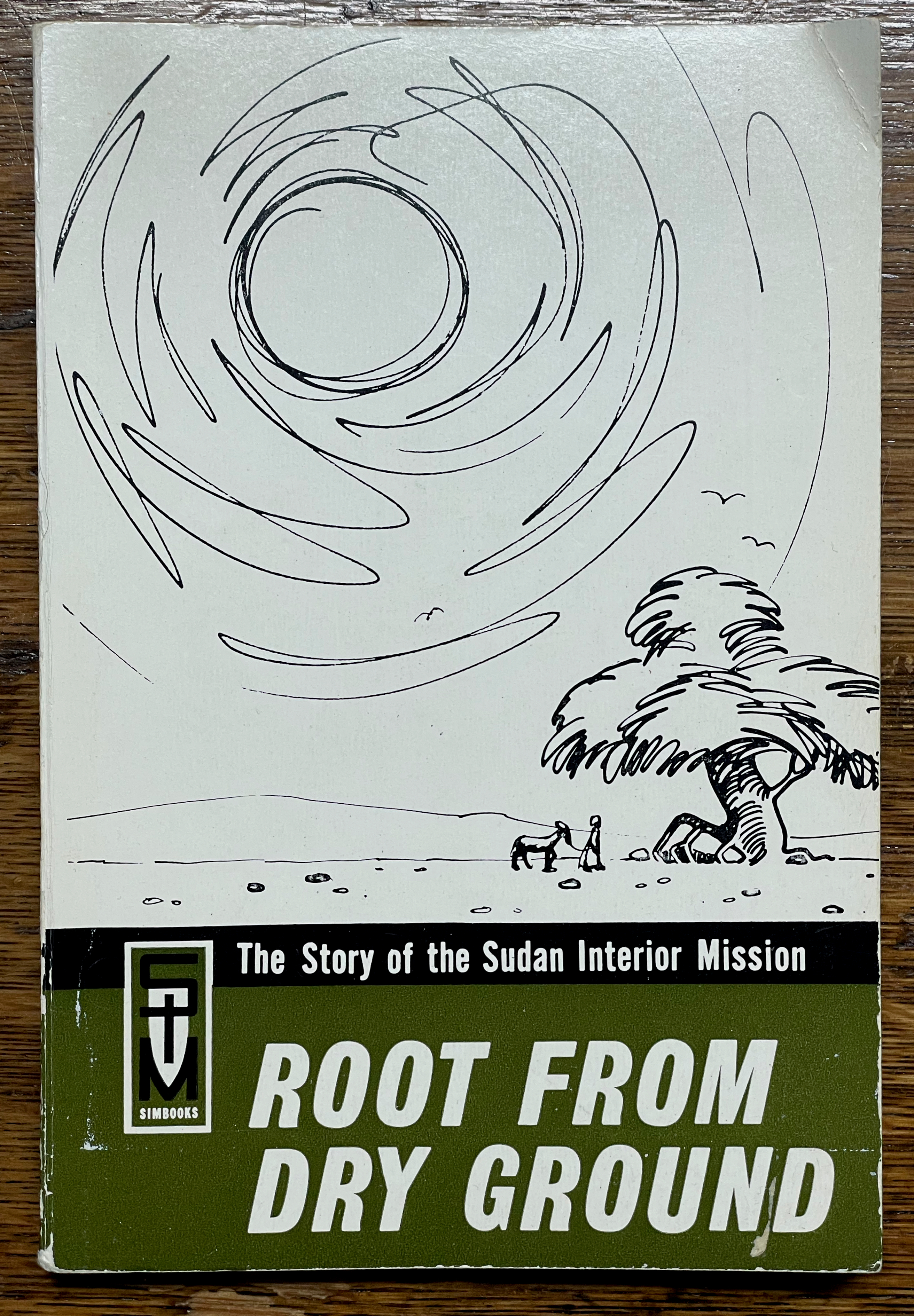
Books — Root from Dry Ground: The Story of the Sudan Interior Mission

A look at SIM’s history from 1966.

Root from Dry Ground: The Story of the Sudan Interior Mission

Root from Dry Ground: The Story of the Sudan Interior Mission was published in 1966 by the Sudan Interior Mission. Although no authors or editors were named, the first five chapters were adapted from an earlier history, Seven Sevens of Years and a Jubilee, written by Dr. Rowland V. Bingham and published posthumously in 1943. The final two chapters of Root from Dry Ground summarize the years from 1942 to 1966, and a presentation that Dr. Bingham gave on “How we became interdenominational” is included as an appendix.

Continue reading
Categories: Books | Tags: , , , , , , , , , , , , | 1 Comment

“Your ‘G’ was perfect…”


Hallo, ek is Brian. Aangename kennis.

Language learning is often (but not always) part of missionary service.

Continue reading
Categories: Stories, News, & Features | Tags: , , , | Leave a comment

Blog at WordPress.com.